
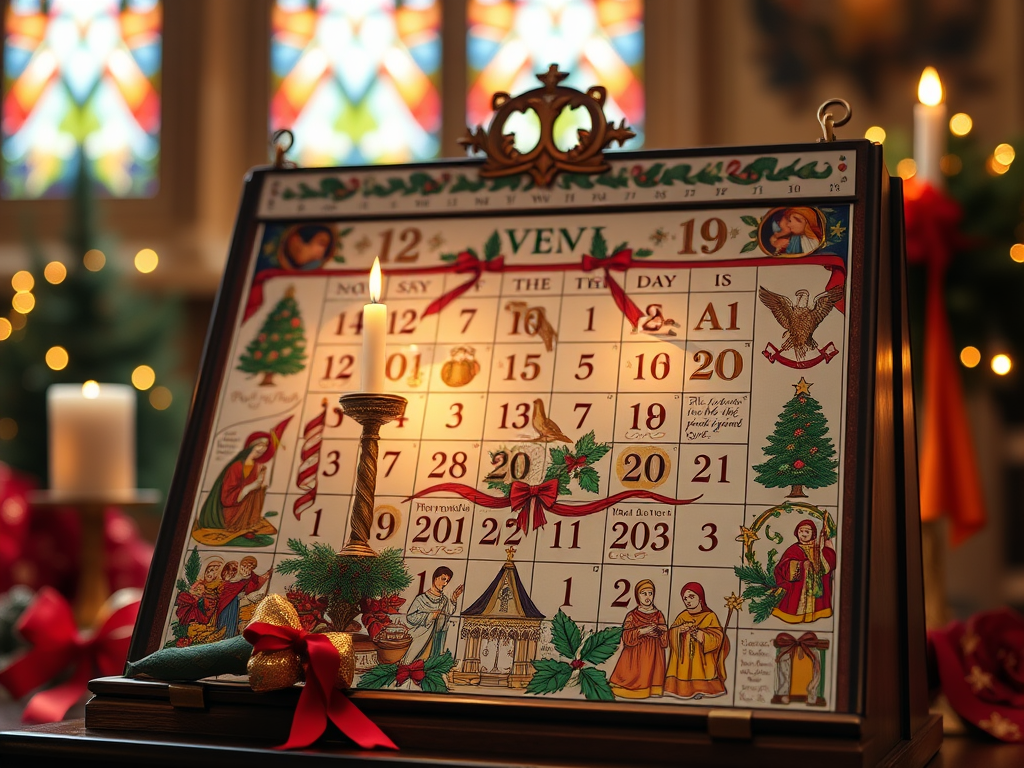
Tired of New Year’s resolutions that don’t stick? Discover the beauty of the Liturgical Calendar. From Advent to Christmastide, learn how tracking the life of Christ creates a rhythm of faith that lasts all year.
Have you ever felt that after the glitter of New Year’s Eve fades, life suddenly feels… stagnant? We work so hard toward our goals, but the world outside remains dark, cold, and dreary. Day after day, we fall back into old habits, thinking, “Maybe next year will be different.”
I know I have. Over the years, I have changed. I’d like to think it was for the better. But it wasn’t because of a resolution I made on January 1st. Any real change in me has been the work of God, not my own doing.
A Different Way of Keeping Time: Our Anglican Journey
About four years ago, my husband Jon and I converted to Anglicanism. I discovered the Liturgical Calendar. It follows the life of Christ rather than the modern traditional calendar. This discovery has completely transformed how I study and interpret Scripture.
I feel so blessed by the ways my family and I can worship together. We cherish our Advent and Lent devotionals. We also appreciate the “Ordinary Times” of daily living. Growing up, I knew the biblical calendar was different. Yet, I never realized how much our modern way of tracking time affects our spiritual health.
The Year Begins with Waiting: Advent and Christmastide
In the Liturgical Calendar, the New Year doesn’t start with a party on January 1st. It begins with the first Sunday of Advent. This is a season of waiting and anticipation for the coming of Christ. We prepare our hearts through prayer, fasting, giving, and study. Using resources like Little Way Chapel’s devotionals has opened my eyes to the true meaning of the season. They have also opened my son Landon’s eyes to this meaning.
Image from Shutterstock
The Twelve Days of Christmas
I used to think “The Twelve Days of Christmas” were the days leading up to the holiday. I was wrong! They are the twelve days leading to Epiphany (January 6th).
This is a time of rest. The hustle and bustle of preparation has ended, and the peace of being together as a family begins. I love keeping the tree up a little longer and enjoy the decorations we worked so hard to put up. We are only in the fifth day of Christmastide. God is using this quiet time to teach me things. I earlier overlooked these things in Scripture.
What is “Brephos”? Lessons from Luke 1
This morning, I was reading Luke 1. I’ll be honest—usually, I skim this chapter. I overlook the coming of Christ and jump right into Chapter 2 where Christ is born. Nonetheless, because the season has begun to slow down, I have had more time. I have thoroughly read through Luke Chapter 1. (How I have completely overlooked the preparations that God had made?) I dare to say this is the most important part. Without the preparation of the birth of Christ their would be no Christ. Or at least now how we know it.
I reflected on Mary and Elizabeth’s time together. In The Life-Giving Parent, I learned that Elizabeth was teaching her unborn son about the coming of Christ. She was also teaching him the teachings of the Old Testament even in the womb. Luke uses the word “brephos” (infant/unborn baby) to describe this. An unborn child is capable of learning the ways of God before he/ or she is ever born. How amazing is that!
“When Elizabeth heard Mary’s greeting, the baby leaped in her womb, and Elizabeth was filled with the Holy Spirit.” (Luke 1:41)
Without the slow pace of Christmastide, I have overlooked the beauty of that moment yet again.
From Epiphany to Ordinary Time
Soon, we will celebrate Epiphany. This marks the manifestation of Christ to the world. The Three Magi, His Baptism, and His first miracle are significant events. We hope to start new family traditions this year. One of these traditions is a Three Kings Cake. This will teach Landon about the beauty of Christ’s ministry to the Gentiles.
After this comes Ordinary Time. Many people worship only during major holidays, but Ordinary Time is where true growth happens. It is the “lived faith” outside of the celebrations. It’s the time when we see who we really are when culture isn’t expecting us to be religious.
The Journey to the Cross and Beyond
Our year continues through:
- Lent: 40 days of repentance and spiritual preparation.
- The Holy Triduum: Maundy Thursday through Easter Sunday.
- Eastertide: A full 50-day celebration of the Resurrection! I love that we celebrate the joy of the empty tomb for nearly two months.
- Pentecost: Marking the birth of the Church and the descent of the Holy Spirit.
Your Cheat Sheet to the Liturgical Year
| The Season | The Mood | The Focus |
| ADVENT | 🕯️ Waiting | Preparing our hearts for Christ’s arrival. |
| CHRISTMASTIDE | ✨ Joy | 12 days of celebrating the Incarnation. |
| EPIPHANY | 🌟 Revelation | Christ being made known to the whole world. |
| ORDINARY TIME I | 🌱 Planting | Following the early life and teachings of Jesus. |
| LENT | 🍞 Reflection | 40 days of repentance leading to the Cross. |
| EASTERTIDE | 🎺 Victory | 50 days of celebrating the Resurrection! |
| PENTECOST | 🔥 Mission | The gift of the Spirit and the birth of the Church. |
| ORDINARY TIME II | 🌳 Fruitfulness | Deepening our daily walk with God. |
My Only Resolution: Pursuing Christ Daily
Through this rhythm, I’ve found a joy that isn’t stagnant. My prayer for the next four years is that my heart continues to learn and grow. My “New Year’s resolution” is simply this: to continue writing, reading, and pursuing Christ. Without Him, there is no hope. And without hope, how can I parent, be a good wife, or pray for a broken world?
I challenge you: Even if you aren’t Anglican, look into the Liturgical Calendar. Celebrate the Feast Days. Study the Saints and Missionaries. Don’t let yourself become complacent in “Ordinary Time.”
What is one way you can challenge your faith rhythm this year? Let’s talk in the comments!
Leave a Reply